
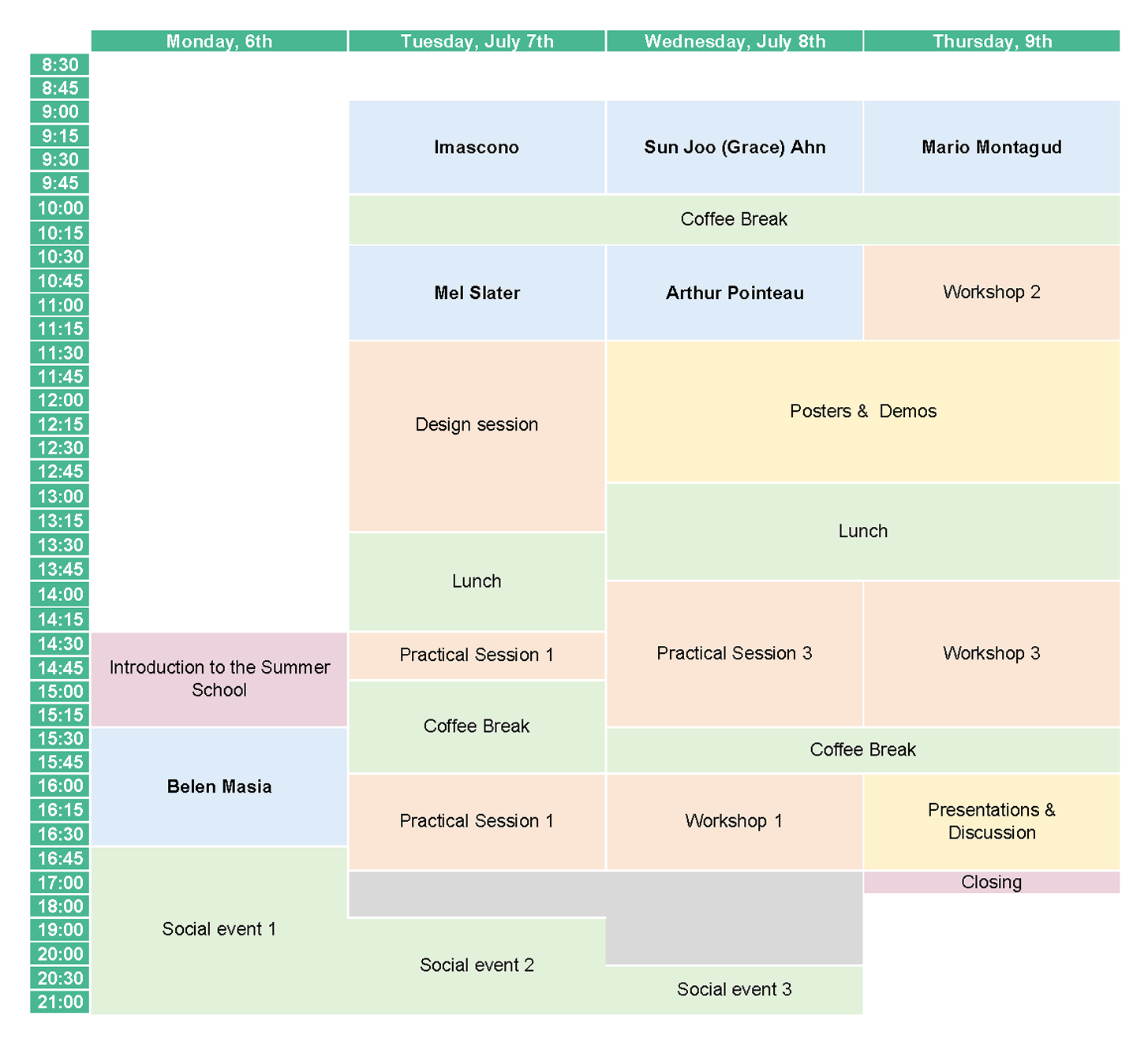
Program
ABSTRACTS
The Tale of Immersive Narratives - Why and How Do XR Experiences Change Us?
Sun Joo (Grace) Ahn
Everyone loves a good story. But immersive narratives are a bit more complicated than just a good story being told; it involves complex interactions between users, XR features, and situational contexts. The Center for Advanced Computer-Human Ecosystems (CACHE) at University of Georgia has worked with countless community organizations to launch large-scale immersive narratives that involve a blend of emerging technology devices, users in everyday environments, and relationships that span across virtual and real social networks. This talk will share the theoretical conceptualization behind some of our largest community studies to date and how their findings guide designing next generation XR systems that can powerfully shape how people think, feel, and behave in the real world.
Towards user-adaptive immersive experiences: Modeling visual behavior and cognitive load in VR
Belen Masia
Creating engaging and compelling experiences in Virtual Reality is still a demanding task. Challenges range from meeting the technical requirements --e.g., large bandwidth, memory requirements, or computation time--, to taking into account human-related factors --such as user control over the point of view, cybersickness, or increased cognitive load--. Understanding and modeling how the user perceives and behaves in these immersive environments can be leveraged to overcome some of the limitations of the hardware and software, as well as to improve user experience. We seek to do this in ecologically valid experimental setups, with multisensory inputs and realistic task-oriented scenarios. Specifically, in this talk we will look at modeling user visual behavior (and how it varies with the task, the type of scene, or the sensory inputs), and we will also tap into the measurement of cognitive load in VR, and its effects on physiological signals such as heart rate or electrodermal activity. These steps towards real-time accurate characterization of the user's status can help deliver improved, user-tailored experiences.
VR + Going Beyond Real Reality Can Lead to Socially Useful Applications
Mel Slater
Virtual Reality is often used to simulate real life. Here we discuss some applications that demonstrate how going beyond real life, beyond what people have or can actually experience, could lead to socially beneficial outcomes. We look at the future, with how a collapse in the environment might influence the mental health of people, and what might result from that. Also we consider the past, where the cognitive and physical condition of older people might be improved by revisiting their situation at a younger age. These two applications, amongst others demonstrate the power of virtual reality to deliver socially useful applications.
What if we could experience the world through another person’s eyes? Since 2012, this question has been at the heart of BeAnotherLab’s research and creative practice
Arthur Tres
In this talk, Arthur will trace the scientific foundations of the collective’s work, reflect on its interdisciplinary methodology, and present a selection of systems and collaborative works developed over the past decade. Through this retrospective, he will share insights from a unique body of antidisciplinary knowledge on how to design transformative embodied experiences, and examine why these lessons are particularly relevant in the current XR landscape.
